
Asbestos & Mesothelioma for Boilermakers
In this episode, we outline where boilermakers encountered asbestos across industrial job sites, the diseases linked to exposure, and what workers and families should consider medically and legally after a diagnosis.
John Maher: Hi, I am John Maher, and I’m here today with Paul Kelley. Paul is a partner with the Kentucky Personal Injury Law firm, Satterley and Kelley, which has over 45 years of collective experience in litigating mesothelioma and asbestos claims. Today we’re talking about asbestos exposure and mesothelioma with boilermakers. Welcome, Paul.
Paul Kelley: Hey, John. How are you doing today?
John: I’m doing well. How are you?
Paul: Excellent, thank you.
Workplaces Boilermakers Served and Asbestos Risk Factors
John: Paul, what are some of the kinds of companies or job sites that boilermakers typically worked at, and why were those environments high risk for asbestos exposure?
Paul: So certainly the most common place that a boilermaker worked is in a powerhouse, boilers were necessary in a powerhouse. That’s what heated the steam in order to generate or send the steam over to the turbine and the turbine generated the power. But that didn’t just occur in your big powerhouses, it occurred on naval ships. Naval ships had boilers that performed the same function, they were just smaller boilers. Steel mills had boilers that were utilized to heat steam in order to keep the facility warm, but also to operate machinery that was in the building. Railroads or specifically trains, back in the day, many years ago, there were steam locomotives that contained boilers, and those boilers frequently contain asbestos.
But there were certainly all kinds of other types of facilities that utilize boilers. Foundries utilize boilers, schools utilize smaller boilers for heating, paper mills and pulp mills utilize boilers. They were in refineries and petrochemical plants utilize boilers. So boilermakers worked in all of these types of environments. And the typical client that we see is someone that worked in this industry as a boilermaker dating from the ’50s into the 1980s, and then they were into the 1990s, and they worked in very old facilities. Many of the powerhouses were built a long, long time ago in the ’50s and ’60s at a time when powerhouses were constructed with asbestos. Many of them worked on naval ships where the naval ships had asbestos all over them. We’re talking World War II vintage, Korean War vintage naval ships.
Trains…now, I will say that I probably haven’t seen too many train workers that were exposed to steam boilers because that technology was fairly well updated by the ’50s or ’60s. But we’ve come across a couple of those over the years, and any facility that was built before 1980, any ship that was built in the ’50s, ’60s, ’70s, they were loaded with asbestos and boilermakers are probably amongst the highest of the trades of receiving repeated exposure to asbestos over the course of many years, particularly for those who started in the industry back in the ’50s and ’60s.
Daily Tasks that Caused Asbestos Exposure
John: So what was some of the daily work that boilermakers did that exposed them to asbestos?
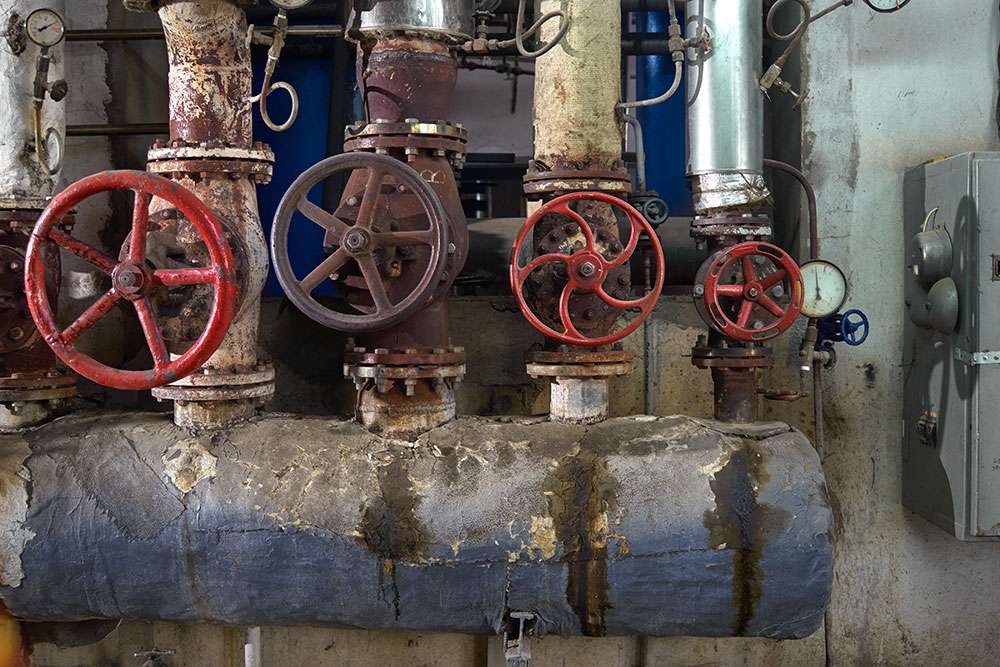
Paul: Probably the main would have to be the construction, demolition, overhaul of the big boilers and the powerhouses. Those boilers frequently had asbestos on both the outside and the inside. Outside, lots of times, would be more of a block insulation that contained asbestos. The inside would be the fire brick and the refractory material. Again, these are 7, 8, 9 story tall pieces of equipment, and they’re just loaded with asbestos-containing materials. They also had piping that was connected that went both to and from the turbines and the piping, and it’s carrying steam that’s hundreds if not thousands of degrees in temperature. And so they had to be insulated and that insulation contained asbestos. There were gaskets and packing that are connected directly to the boiler. We frequently would hear about the doors. These aren’t little itty bitty doors. These are very large doors, and they had to be maintained, and there were gaskets and packing material that went on these doors and oftentimes had to be replaced.
The problem is that when a gasket has been on a piece of equipment that generates thousands of degrees in temperature, it has to be scraped off. It’s not an easy thing to do. So that’s probably the most common. But certainly when you’re talking about some of what we call the more packaged boilers or smaller boilers in a manufacturing plant, there’s still going to be other pieces of equipment in addition to the boiler itself that were insulated with asbestos. Whether it’s…sometimes you’ll see exhaust equipment that’s attached to the boiler that was insulated with asbestos or contained asbestos. You’ll see fans, exhaust fans that are extremely large, the size of a room, that would have asbestos insulation inside the fan, would also accumulate asbestos within the fan itself. And then the boilermakers are exposed to the turbines that are at these powerhouses.
And the powerhouses or the turbines were loaded with asbestos. Usually there was a blanket and block insulation that covered the turbine, and they were in close proximity to the boiler. And while the boilermakers are working on the boiler, the millwrights are working on the turbines, and they were exposed. They were of course exposed during the insulation process, bricklayers typically put in the brick and refractory material, but the boilermakers were typically there when that happened. They used saws and grinders and wire brushes to do a lot of the work they did, and powerhouses and manufacturing facilities, they’re just not very clean. And because they were loaded with asbestos, based on the timeframe that they were constructed, boilermakers were heavily, heavily exposed, and that exposure went on for decades for many of them.
Long‑Term Health Effects from Asbestos Exposure
John: So how has all of this asbestos exposure affected boilermakers over the years? What are the long-term health risks of asbestos exposure?
Paul: So doctors and scientists have studied various crafts and trades to determine risks for cancer or disease associated with asbestos and various work and boilermakers, they’re up there towards the top. They’ve had a lot of exposure, and those diseases are frequently devastating. I think a lot of people have heard about mesothelioma. It’s fatal cancer, it impacts, most commonly the lungs, or the area around the lungs, but also can impact the heart, can impact the area around the abdomen. And these are terminal cancers, and a lot of boilermakers have contracted that disease. Lung cancer is very common amongst boilermakers. Of course, we know that smoking is a significant risk factor for lung cancer, but asbestos exposure is too by itself. And then you put two together and it’s really increasing someone’s risk of contracting lung cancer and boilermakers have been amongst the high risk group for lung cancer.
There are what we call nonmalignant diseases. Asbestosis is a scarring of the lining of the lungs or the scarring of the lungs, and it impacts the lung’s ability to expand and retract. And if it’s scarred badly enough, then it can’t serve its function and people can suffocate to death. It’s a terrible, terrible disease. And so boilermakers have been studied, and they’re not just at risk for getting the disease. Boilermakers, in fact, frequently have gotten these diseases. And we’ve had the opportunity over the years to represent dozens of them. And it’s unfortunate, but they’ve been at high risk and have suffered the devastating impact of a lifetime of asbestos exposure.
Long‑Term Health Effects from Asbestos Exposure
John: And looking back, what did companies know about the asbestos risks for boilermakers, and did they let the workers know about those risks?
Paul: So, a lot of the companies…and this one’s unique because you’ve got the boiler manufacturers on top of the owners of all these facilities. And so the boiler manufacturers, these were sophisticated companies that designed the boilers. They were experts in that. We’ve seen dozens of specifications for boilers, and they specified it with asbestos. So they knew it was there and they knew that it was harmful. They frequently belonged to trade organizations that studied the health impacts of asbestos exposure. And they studied it, particularly from the perspective of their pieces of equipment. And frequently they became aware that the pipe insulation connected to their boiler put people at risk of disease or the refractory material or the block insulations on the boiler put people at risk of disease. I don’t think I’ve ever seen a warning, ever, associated with asbestos on a boiler that was put out by a manufacturer.
They still maintain to this day that their products were harmless and wouldn’t cause disease. But internally, they told a different story, and internally they acknowledged the significant health risks associated with asbestos. And it wasn’t communicated to people like your average boilermaker. So that’s the manufacturers.
Then you’ve got all the places that these boilers were put into and big-time powerhouses that were owned by very sophisticated companies, manufacturing facilities that were owned by some of the oldest, most respected companies in the United States. And they certainly knew what was present on their property. They knew that there was asbestos on the boilers and the turbines and the piping on the duct work. And they were aware of all that and they were aware of the hazards associated with exposure to asbestos.
And again, I can’t think of any instances where they told the boilermakers, “You need to be careful. You need to do certain things in order to protect yourself from exposure.” And as a result, boilermakers went in and did this work, many of them for decades. And that work, it’s very complicated. Being a boilermaker is not an easy job. It’s physically demanding, it’s intellectually demanding.
And what we hear a lot is that their union put out some information and advised that there’s some health risks associated with asbestos and here’s some ways that you’d be exposed. Well, there’s a couple issues with that. First of all, lots of times these boilermakers have been involved in the trade for years, so wouldn’t have…
John: It would be too late. Right.
Paul: Yeah. And then the other issue is they’re working 60 to 80 hours a week. They have families and they don’t have time to sit around and dissect journals and try to understand sophisticated, complicated medical issues. But the irony of it all is that in most instances, the unions that had no obligation, responsibility, duty whatsoever were the only entity that really tried to give any information to the boilermakers about any hazards associated with their jobs. The property owners didn’t, the manufacturers didn’t, distributors didn’t. So the parties that actually had the duty didn’t do anything, didn’t make an attempt. And then years later, they try to either blame the union or at least say, “Well guys, the union made this information available and you didn’t follow it.”
And it’s like, well, first of all, most of my clients, they never heard about anything that showed up in any sort of journal. But even if they did, there was nothing they could do about it. It required everybody up the chain to do something about it. The union couldn’t stop an unsafe condition. The employee couldn’t refuse to do something. Not unless they chose to just leave their job. But think about that, think about if every boilermaker was actually given actual knowledge, definitive knowledge, and the manufacturers went to great effort to educate, and the property owners and the powerhouses and all these places, they went to great effort to educate and to post signs and those sort of things. Just think about what would happen if boilermakers armed with that information said, “We’re not going to do the work.”
John: Right. It would force change.
Paul: Right. We wouldn’t have electricity. We would pay a heck of a lot more for it. So quite frankly, it’s probably the most disingenuous argument that I’ve ever heard in any case that I’ve ever had, that the union had some responsibility that the manufacturers and property owners didn’t have. It’s not true, but any information that they provided to their members was completely gratuitous and out of the kindness of their heart, really. But the parties that really had the responsibility didn’t do anything and then they tried to hide behind all of these facts. Decades later when somebody gets sick and says, “Well, gosh, Mr. Boilermaker over here should have been aware because of this obscure article that appeared in the 1978 Boilermaker Journal.”
John: Right.
Paul: And that’s not realistic, and it’s not the law. And I think that the juries see through that kind of thing, because the question that they’re always going to be asked is, “What did you do, Mr. Defendant? What did you do, Manufacturer? What did you do, Property Owner, Mr. Powerhouse or whoever? If the answer is you didn’t do anything, we’re not going to let you off the hook because there was an article or two over 30 years in the Boilermakers’ Union’s Journal.”
Medical and Legal Steps After a Diagnosis
John: Right. So if someone worked as a boilermaker and now has later been diagnosed with mesothelioma, what steps should they take medically and legally?
Paul: So medically, the only real advice I can give is to make sure that you’re comfortable with your medical plan. That’s something that’s very unique to you and to your family and to your medical team. And there’s a lot of options out there, which the doctors can certainly talk to you about all of that. But because of the treatments and the opportunities are significantly better now than they were 20 years ago, my advice is to explore them all and make the decision for yourself and that you and your family decides best for you. From a legal standpoint, which is what we do, time is a bit of the essence. We do have a statute of limitations in Kentucky that’s only a year, essentially from the date of diagnosis, but that’s not the only reason to get on it. You really want to pursue your legal rights so that you have an opportunity to participate in your case.
We do have clients that have lived for four to five, six years after diagnosis, but that’s not the typical scenario. The typical scenario is somewhere between six months and a couple years, and it’s just not a lot of time. And you have a lot of important things to worry about, your medical care, handling your personal affairs, spending as much time with your family as you can. But if you want to pursue a claim and you should at least investigate them, I say that to everybody. At least investigate, and investigation requires talking to a lawyer that knows what they’re doing, knows the right questions to ask, hopefully knows, if not the properties that you were involved with, but the kinds of properties and knows the right things to look for, and somebody that you feel comfortable with, somebody that you feel is going to take that extra step for you and your family and try to get the compensation that you deserve.
No two cases are alike. Every case presents unique challenges, and I haven’t seen everything, but I feel like we’ve seen a lot. And universally when we get done with my client’s deposition, which is really my singular focus when you come to me, is when can I get a deposition in? And the weight of the world is taken off their shoulders, sometimes physically, but emotionally, to be able to tell everybody what’s happened to them. And the exposures are important. That’s where the case is at, being able to show the exposure. But I think that most of my clients really feel so much better after they’re able to get it off their chest, what’s happened to them. That two years ago they’re humming along just fine, living their life, usually in retirement, and doing the things they want to do, and now their lives are nothing but doctor’s appointments and procedures and chemotherapy and sometimes surgeries and side effects from the various types of treatment.
And no more vacations and golf and simple activities like going on a walk on a nice day. And they like to have the opportunity to say that. And so that’s what I want for you, I want for you to be able to tell your whole story. And the part of your story that’s going to help us succeed is certainly how you were exposed to asbestos, but the part of the story that’s going to help you emotionally is the part about what’s happened to you. And then also that gives us something to be able to present to a judge and jury to indicate this just isn’t about a faceless person. This is about someone and his or her family who’s been deeply impacted by this cancer. And we’ve represented so many boilermakers who have had that opportunity to do that and not only did they help their case, but I think in some way they helped themselves cope with what it is they’re dealing with.
John: All right. Well, that’s really great information, Paul. Thanks again for speaking with me today.
Paul: Thank you so much, John. I appreciate it.
John: And for more information about mesothelioma and asbestos exposure, you can visit the law firm of Satterley & Kelley at Satterleylaw.com or call 855-385-9532.