
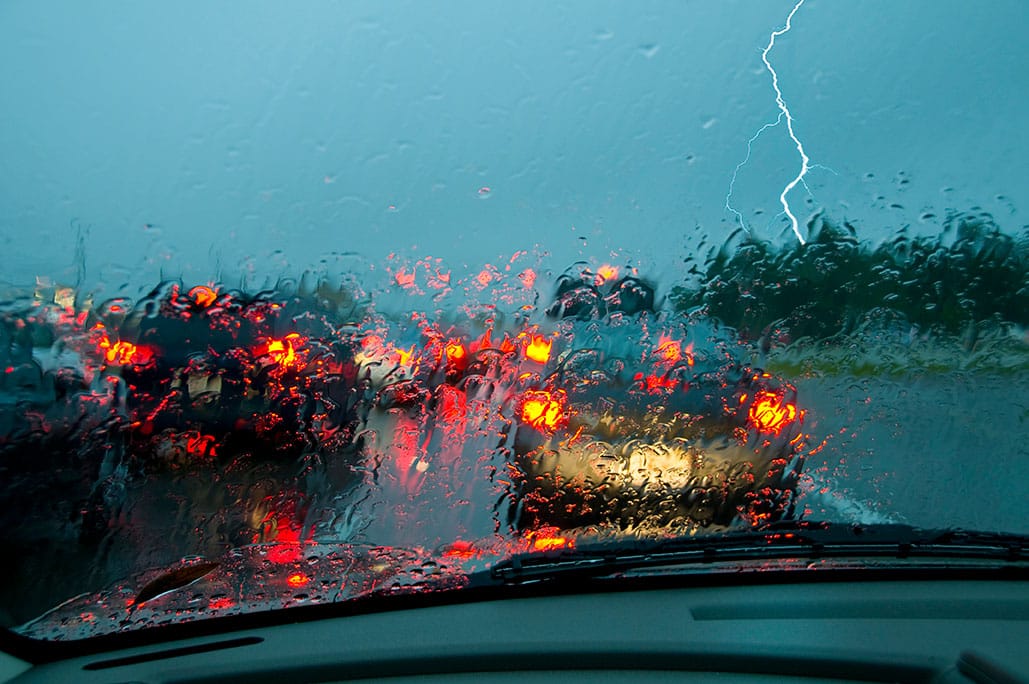
Bad Weather Doesn’t Excuse Negligent Driving
If you’re driving in poor weather conditions, your risk of an accident increases because visibility may be limited, and water or snow-covered roads may sharply reduce tire traction. But if another driver acts negligently in these conditions, strikes your vehicle, and injures you, bad weather is not an excuse.
Everyone must drive reasonably safely, given the conditions. Accidents in lousy weather often happen because drivers maintain the same speed, whether or not it’s dark, rain is pouring down, or there’s a snow storm. Driving too fast for the conditions may not only earn you a traffic ticket but also negligence, which can be the basis of a car accident injury claim.
Another issue is reasonably maintaining your vehicle. If your tires lack enough tread to handle wet or snowy roads, you shouldn’t use them. If your windshield wipers are so worn your windshield is about as clear as wax paper in a rain storm, they must be changed. Your driving and your vehicle must be reasonably safe when you’re on public roads.
Poor Weather Accidents by the Numbers
Weather-related accidents are those that happen in adverse weather conditions (rain, snow, sleet, severe crosswinds, fog, or blowing snow/sand/debris) or on slick pavement (it’s wet, icy, or covered in slush or snow), reports the Federal Highway Administration. They state that from 2007 to 2016:
- There were more than 5,891,000 vehicle accidents annually
- About 21% of them (nearly 1,235,000) were weather-related
- On average, 5,376 people were killed, and 418,005 people were injured in weather-related crashes during each of those years
- Most weather-related crashes occurred on wet pavement (70%) and while it rained (46%)
- 18% happened while it snowed or sleeted
- 13% occurred on icy roads
- 16% took place when roads were snowy or slushy
- 3% occurred when it was foggy
The most common adverse weather condition for accidents was wet roads, accounting for 15% of weather-related crashes (860,286), 15% of injuries (324,394), and 12% of fatalities (4,050) each of the years studied.
Why are Wet Roads Dangerous?
Tire traction, which makes it safe to stop and steer, is based on friction between the tire and the road surface. If there’s too much friction, it would be like driving on glue. Not enough friction, and it’s like driving on ice. You need enough to control the vehicle but not so much that you can’t get where you want to go.
Water mixes with oils and residues left by cars and other sources on the road to create a slippery layer that reduces friction and tire traction. As more water accumulates, this mix grows, making the road surface more dangerous.
Tire treads are designed with different goals, including noise reduction, speed, and traction on water or snow-covered roads. The treads should push water away from the tires so they can be on the pavement. That’s more difficult if the tires are poorly designed for wet roads, the treads are worn, there’s too much water, the vehicle travels too quickly, or a combination of these issues.
When the water can’t escape through the tread, the tire can rise and float on the water, causing hydroplaning. Since the vehicle’s not on the pavement, it’s like surfing, and a driver has far less control of the vehicle. If the driver is heading straight ahead, not turning or braking, they may not realize this is happening.
Less traction results in a higher risk of a crash. Vehicles are more difficult to control because they’re harder to safely brake, steer, and accelerate on wet surfaces, especially if they’re hydroplaning. Trying to turn, stop, or accelerate suddenly can result in fishtailing, spinning out, or the inability to steer the vehicle where you want it to go.
How Would This Affect an Insurance Claim or Personal Injury Lawsuit?
Every driver should drive reasonably safely in a reasonably safe vehicle, given the weather and road conditions. Whether there’s light rain, sudden downpour, snow, or fog, the driver must control the vehicle.
That usually means slowing down to the point where the driver has sufficient control, more time to react, and more distance to stop the vehicle. If weather conditions are so severe that it’s unsafe to drive at any speed, the driver should safely get off the road and park the vehicle where it’s safe until conditions improve.
If the driver isn’t doing these things, and as a result, crashes into you and causes injuries, they are driving negligently, and their insurance company should compensate you for the damages you incur.
It’s not a defense to claim the driver’s not negligent because how they drove would’ve been safe under ideal conditions. The issue is their driving during the conditions at the time and location of the accident.
In bad weather, who caused the accident may be disputed. The insurance company may claim you were the one who was out of control and at least partially responsible. They may deny liability or claim that your compensation should be cut to reflect your share of the blame (known as comparative negligence).
You should slow down in adverse weather and drive safely to avoid causing a crash. Additionally, if there is one, you may recover more compensation if you’re driving as you should, but the other driver is not and slides into your vehicle.
Speak To a Satterley & Kelley, PLLC Vehicle Accident Lawyer Today
If you or a family member is injured in a vehicle accident in bad weather conditions, we can help you recover the full and fair compensation you deserve. Let us be your boots on the ground and guide you through the process.
To speak with an experienced attorney at our firm, contact our Louisville office to schedule a free initial consultation. Call us at 855-385-9532 or reach us online through our contact form.