
Brakes and Mesothelioma (Podcast)
In this podcast, Paul Kelley explains the history of asbestos in brakes and friction products. Then, he talks about who was exposed and what to do if you have been diagnosed with mesothelioma or another cancer due to exposure to asbestos in brakes.
John Maher: Hi, I am John Maher and I’m here today with Paul Kelley. Paul is a partner with the Kentucky personal injury law firm, Satterley and Kelley, which has over 45 years of collective experience in litigating mesothelioma and asbestos claims. Today we’re talking about brakes and mesothelioma. Welcome, Paul.
Paul Kelley: Hey, John. How are you doing today?
John: Good, thanks. How are you?
Paul: Doing well.
History of Asbestos in Car and Truck Brakes
John: Yeah. So, tell me a little bit, Paul, about where asbestos has historically been used in brakes for cars and trucks.
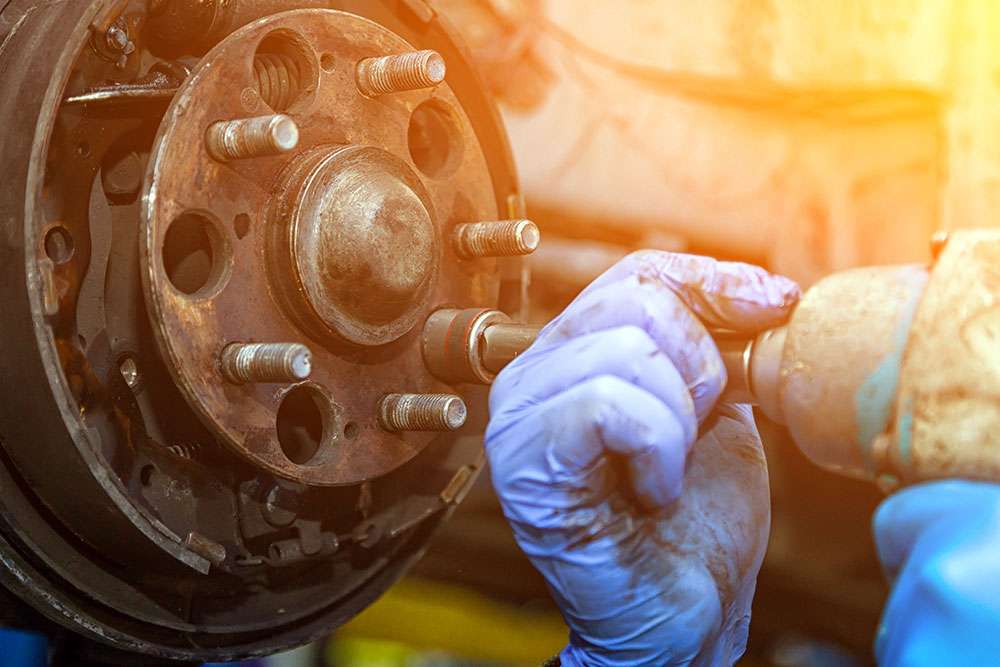
Paul: So, John, historically, asbestos has been used in both drum brakes and disc brakes back in the ’40s, ’50s, and ’60s and really through the ’80s, most brakes were drum brakes. And so, you had a drum, you had two linings. They were moon shaped and they operated to brake, to stop the vehicle.
And then as we got into the ’80s and ’90s, and probably what’s most common today are disc brakes. And so, historically, the asbestos has been the linings in the drum brakes, so those little crescent segments. And then with respect to the disc brakes, it’s the pads. So, you’ve got a disc and you’ve got the pad, or the two pads and the pads work with a disc to stop the vehicle from moving.
John: And those pads and linings are on there basically so that you don’t have a metal piece scraping against the metal piece of the wheel. You don’t want that metal on metal, so they have these pads to absorb the impact, if you will.
Paul: Absolutely. Brakes wouldn’t last very long if you didn’t have something to prevent the metal on metal process.
Is There Still Asbestos in Brakes?
John: Has the use of asbestos now stopped in brakes?
Paul: Well, certainly in the United States it has. I believe the last documented manufacturer of asbestos containing brakes in the United States was probably around 2001. That having been said, I believe that internationally there’s still some companies that sell asbestos brakes. They’re probably not sold in the United States, at least not on a primary market. It’s not to say that they can’t make them here secondarily. And certainly in parts of Asia, probably Africa, maybe even parts of Europe, you could probably still buy asbestos-containing brakes today.
Who Was Affected by Asbestos in Brakes?
John: Yeah. And who would typically be exposed to the asbestos that’s found in brake linings and pads?
Paul: Oh gosh, a lot of folks. So, certainly, John, you would have the people who manufactured the brakes. And usually they worked with the supply of raw asbestos, and they would mix the materials. And people that were in the plants that made the linings and made the brake pads would certainly get a high level of asbestos exposure.
Then in addition, the people who manufactured cars and were responsible for installing the friction products onto the cars. We call brakes, friction products. So, the pads, linings, clutches, even those whole systems are what we call friction products.
And people who worked in these manufacturing plants and made a car, and they’re on the assembly line, and all they’re doing all day every day is putting brakes onto a car, putting the linings on, putting the pads on. And they were exposed in a variety of different ways from doing that.
Sometimes they had to sand the linings in order to get them to fit onto the drum. Sometimes there would be imperfections that were on the linings that they want to take a piece of sandpaper or some type of cloth and rub it off. Sometimes they grinded the linings in order to make them even more smooth and able to fit on. Sometimes they had to cut the linings because they might be too big. So, people who were engaged in the vehicle manufacturing process.
Then after that, you’ve got the people that worked in the automotive garage mechanic industry. I mean all the auto mechanics. There was a time when there were tens of thousands of mom-and-pop auto mechanic shops throughout the United States. In 2023, cars have gotten so sophisticated that you see a lot of auto dealerships and big operations. But I mean, it used to be that you couldn’t walk five blocks in most cities and towns without finding a small mechanic shop.
And the main work that they did back then, oil changes, filters, and they did a lot of brake work. Brakes wore out back in those days. They probably wore out even quicker than they do today. So, automotive mechanics were exposed quite frequently. We’ve seen people who worked for bus companies that have huge, heavy duty brakes on those vehicles, and they were involved in the inspection process. They were involved in things that might not have to do with the actual replacement of the brakes. But these things, when you stop a two ton bus, it applies so much friction that dust flies in the air and people could be exposed in that way.
We have represented a number of people that worked in the mining industry. So, coal mining is very prominent here in Kentucky. And in other parts of the world there’s talc mining, and other precious metal, and rock mining. And a lot of the equipment they used contain brakes and friction products that contained asbestos. So, the mechanics, the electricians, people that had to work on those types of vehicles were exposed to asbestos from those products.
In addition, sometimes brakes were used to operate industrial equipment. So, things that are not on the road, but things that are in a manufacturing plant. And they operate with motors and other sophisticated processes. And sometimes those pieces of equipment contain asbestos-containing brakes, friction products. And so, the people that are operating those machines, they change them out. They’re constantly stopping and applying that pressure that dust keeps flying up. And then sometimes in major industrial cities, maybe not so much today, but probably in the ’60s and ’70s, there were studies that so many vehicles, I mean every vehicle had asbestos-containing brakes.
And so, in New York City, Boston, Philadelphia, I mean you name the major metropolitan city, there were higher levels of asbestos that were just generally in the air that people had exposure to from all these vehicles constantly braking every two seconds in a major metropolitan area. And it’s not as much of a problem today, of course, because we don’t have a lot of asbestos brakes. But it got better over the years just from companies, and cities, and industrial hygienists being a little bit more aware of the processes. But it was a really bad problem in the ’60s or ’70s.
And then probably the final group is family members whose loved ones worked in all the kinds of ways that we’ve talked about. Auto mechanics, manufacturers of the products, and people that were in the mining industry, their spouses or their children frequently were exposed to asbestos dust that got onto their clothing. They unknowingly brought it home to their wife, or their kids, or their husband, and there was an exposure.
Secondary Exposure for Family Members of People Who Work With Asbestos-Containing Brakes
John: Right. They tossed it in the laundry or something like that, and that dust is flying everywhere in the laundry room.
Paul: Absolutely. And unfortunately, because there was not much awareness in the general public at that time, people didn’t just come home and change out of their clothes. I mean, if they weren’t covered in oil and grease and that sort of thing, if it was just some dust, they’d come home and lounge around on the couch or at the kitchen table, hug their kids. And lots of times the dust would get into the house, it would get into their carpeting, their furniture, their cars.
And there is very special and highly sophisticated equipment that has been developed over the years to remove asbestos from industrial settings. If somebody came into a plant down the street from where I’m at today and they needed to remove asbestos, they wouldn’t just come in and bring some standard Hoover vacuum cleaner. They have to bring in highly specialized equipment in order to remove that dust. And even then, it’s not a thousand percent perfect.
So, imagine back in the ’60s, ’70s, ’80s, ’90s, a husband or a wife comes home after working in an auto garage all day every day where they’re doing dozens of brake jobs, and they’ve got dust all over their clothes, and it gets into the house, there’s no real way to remove it. I mean, maybe over a period of years, if there was never any more exposure, again, maybe eventually it would be gone.
But if day in and day out, year, after year, after year they’re bringing it home, it’s in that house and it’s never going away. And there’s no domestic piece of cleaning equipment that can remove asbestos dust, whether it’s from brakes or something else from your home. And a lot of people that I’ve represented over the years, unfortunately, were unknowingly exposed in that way.
And unlike folks that are exposed in the occupational setting, I mean, they have no chance. I mean, they’re not warned. They wouldn’t have the equipment to protect themselves, and they certainly don’t have the knowledge. So, brakes contained asbestos in this country prevalently through the early 2000s. And unfortunately what that means, John, is a lot of people are going to develop asbestos cancers probably for the next 30 or 40 years as a result of that.
Who Manufactured Asbestos-Containing Brakes?
John: Right. Are there specific manufacturers of brakes that are documented to have contained asbestos? Or maybe certain locations or countries where the use of asbestos and brakes was common?
Paul: Sure. So, in the United States there were certainly dozens of manufacturers. But a couple of the bigger ones, there was a company called Bendix. Bendix doesn’t exactly exist today. It was bought out eventually by a company called Honeywell, that I’m sure everybody’s familiar with. They still sell the Bendix line of brakes today because it was the most predominant manufacturer of all friction products dating back to the ’50s, ’60s, and moving forward. It was such a big name that when Honeywell bought out that product line, they didn’t change the name of the brakes because it was synonymous with quality and whatnot.
Unfortunately, all of their brakes contained asbestos through the early 1980s. And then even when they started to phase them out, they didn’t just go cold turkey. I mean, they had a non asbestos product line, and then eventually they did get rid of it. All of your automobile manufacturers, Ford, Chrysler, GM, all of your foreign manufacturers, they all had their own brake line. Now, a lot of those may have been the linings themselves were probably supplied by a company like Bendix, but they were sold under the Ford name or they were sold under the GM name.
And you know the kind of people I’m talking about. If they bought a Ford, the only people that worked on that car was the Ford dealership. And if it was the Ford dealership, they were putting a Ford brake onto that vehicle. And at least until the early 1980s, and if it was a drum brake in particular, it contained asbestos, no question about it. And the same would be true for pretty much all of your auto manufacturers.
Of course, foreign cars probably didn’t become a big deal in this country until the ’80s and in the 1990s, but they all basically had their own product line. There were other companies, a few of them have gone into bankruptcy. But a company called Abex was also a big manufacturer of asbestos-containing brakes, historically probably stopped in the mid 1980s. Carlisle, that’s a company that predominantly manufactured heavy duty brakes for your big semi trucks. And Carlisle manufactured asbestos brakes, at least till the mid 1980s, if not the early ’90s.
A company called Rayloc or Rayloc was the product line. People were probably more familiar with NAPA Auto Parts, a company called Genuine Parts. But that was a very, very predominant and prevalent product line. People walked into their NAPA store and they bought Rayloc brakes. And those brakes contained asbestos for the most part deep into the 1980s. So, there are many, many, many more. And the rule of thumb is if you did that work before 2001 in any way, whether it was in the manufacturing plant or the automobile mechanic industry, guaranteed you were exposed and probably guaranteed you were exposed a lot.
Manufacturers Used Asbestos Brakes Until the Early 2000s
John: Absolutely. Yeah. And you said that some of the brakes actually contained asbestos all the way up until the early 2000s?
Paul: Yeah, absolutely. And I think it’s probably because cars last for a long time if people take care of them. So, if a car was designed with an asbestos-containing brake, it was better to replace it with an asbestos-containing brake. I think there became a point where A, a lot of those vehicles were just not on the market anymore. But I think it also came to a spot where they developed non-asbestos alternatives to put on those vehicles.
But no doubt. And we’re aware, there was a plant here in Kentucky, it was actually a Rayloc plant. And we know for a fact that that plant manufactured brakes that contained asbestos until 2001. And some of the linings that were used in that plant were supplied by Bendix or the Bendix product line. And that’s conclusively documented and proven in cases that we’ve been involved in.
And so, the concern is that with the long latency period, and what that means, John, is how long it takes to develop a disease from the first exposure, and mesothelioma has a very lengthy latency period. It can be as little as 10 years, but that’s rare. It’s usually in a range of 20 to 60 years. So, that means that somebody could be exposed in their twenties for the very first time, and they very well may not develop that disease until their ’60s or ’70s. So, if you’re doing the math, somebody that was a teenager in 2001 doing brake work, they’re at risk their entire lives. And I fully expect that there will be a certain percentage of people that did that kind of work through 2001 that unfortunately will develop this cancer.
The good news is it’s highly unlikely people are being widely exposed to asbestos from friction product work now. But to be perfectly frank, it really doesn’t matter for all those people that were exposed prior to 2001. And we probably don’t need to get too deep into it, but these manufacturers and distributors of these products were well aware in the ’60s and ’70s, maybe even the 1950s, that asbestos was a carcinogen, that it would expose people to hazardous levels of dust from doing brake work, and that people would develop cancer.
So, what’s happened is as we get into 2023, I’m not here to speak on statistics, but I can tell you that there’s been tens of thousands of cases involving people that either professionally did brake work or did what we call the shade tree mechanic work, where they did it at home for family and friends that have developed mesothelioma.
And a large percentage of those people never had any exposure other than the brakes. And so, my adversaries will say that their products don’t cause cancer, even though they knew back in the ’60s that they did. But I think the evidence is sufficient to indicate not only can it cause cancer, but it’s caused cancer for an awful lot of people over a very large period of time. And it took them probably 25-30 years before they took the product off the market, after we started seeing all of these mechanics and factory workers or assemblers being diagnosed with asbestos cancer, mesothelioma.
What to Do If You Have Mesothelioma Due to Exposure to Asbestos in Brakes
John: And what should someone do if they believe that they now have mesothelioma? And I think that it was caused by the asbestos that’s in these brick linings and pads.
Paul: Well, there’s so many things that the people do need to do. Unfortunately, in Kentucky where I’m at, we have a one-year statute of limitations to file a claim. That’s one year from the date that you know or should know that you have an injury, and know or should know the cause of the injury. But my rule of thumb is one year from the date of diagnosis, because you don’t want to run the risk that a judge or jury may have a different opinion as to when your statute ran.
So, it’s important to contact a lawyer immediately and start discussing the options. The other big problem that folks have, of course, is their medical situation. Mesothelioma in particular is a terminal cancer. The statistics are very grim for people who have been diagnosed with that disease. And there’s a life expectancy of about 12 to 18 months from the date of diagnosis.
So, people who are diagnosed with mesothelioma have two things that they really have to worry about. One is what their legal rights are and how to hold those accountable for causing their cancer. And then the more important issue is to take care of their medical situation as best they can. There are surgeries, there’s various treatments, and the science is getting better.
But I tell everybody, unfortunately, you don’t have the luxury of getting your medical care completely worked out and have a plan in place. It’s really important to talk to a lawyer, do your research, find lawyers that have had experience with asbestos cases, and specifically experience with automobile brake cases or friction product cases. It’s highly specialized. People don’t dabble in what we do successfully. And these defendants have a unique defense in these cases. And so, it’s important to hire somebody that knows how to deal with those defenses, and respond to them appropriately, and be successful for you and your family.
This is a terrible time of need that people will be in when they’re diagnosed with this cancer. And they just need to find the right attorney that they feel comfortable with, they can develop a good relationship with, and certainly an attorney that doesn’t need to recreate the wheel, so to speak, when the case comes in. That they’re prepared to hit the ground running. And I feel like my law firm is uniquely situated. Particularly here in Kentucky, we do a lot of that work. And quite frankly, a lot of what we’ve done over the last 10 years has been a lot of friction product work because as we predicted, there would be a lot of these cases and there have been, and there will continue to be many cases.
Contact Satterley and Kelley to Learn More
John: Okay. All right. Well, that’s really great information, Paul. Thanks again for speaking with me today.
Paul: Thank you, John.
John: And for more information about mesothelioma and asbestos exposure, visit the law firm of Satterley and Kelley at satterleylaw.com or call 855-385-9532.