
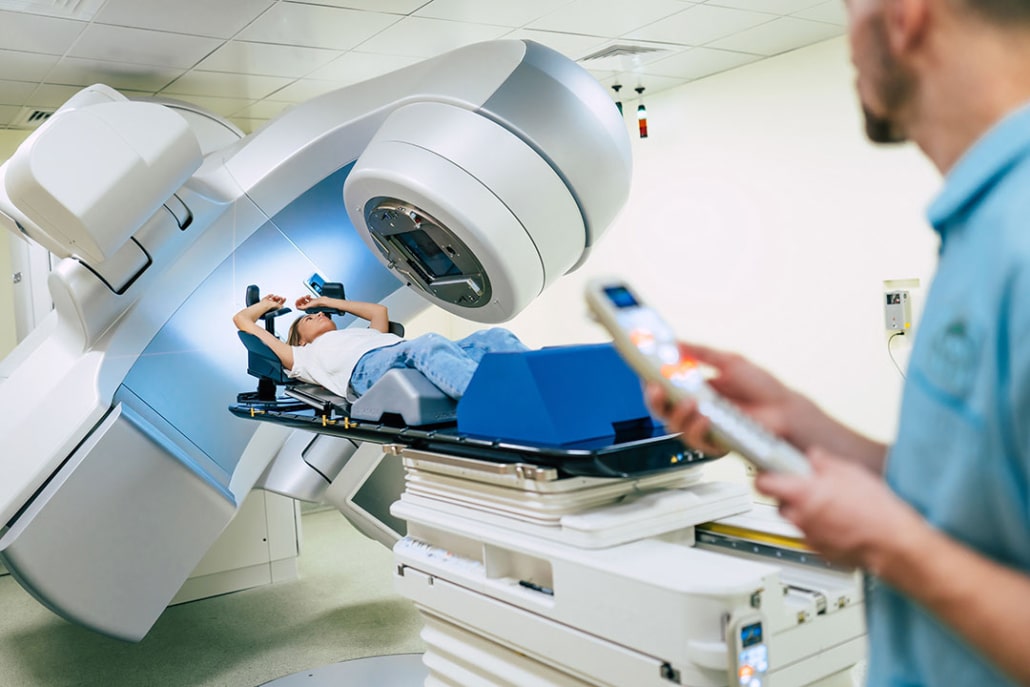
Radiation for Mesothelioma: 101
Radiation therapy is one of the most common treatments for many types of cancers—including mesothelioma. Still, despite how commonly it is used, many people don’t actually know what radiation therapy is, or how it is used—including in mesothelioma care. In this article, we’ll break down the basics about radiation therapy for mesothelioma patients, de-mystifying this vital treatment that can help improve prognosis and quality of life.
What is radiation therapy?
“Radiation therapy” or “radiotherapy” refers to the use of highly concentrated rays of energy (“ionizing radiation”) to kill or damage the DNA of cancer cells. Specifically, radiation damages or removes the internal instructions inside the cancer cells that tell them how to multiply, grow, and infect other parts of the body.
Radiation is often directed at specific parts of the body, generally where tumors or cancerous tissue is located. Imaging tests can help locate the cancer’s exact location in the body, so that doctors can direct radiation to that location.
There are two types of ionizing radiation frequently used to treat cancer:
- Photon Beam Radiation is essentially an X-ray at a much higher dose, and has been the form of radiation most commonly used to treat mesothelioma. When a patient receives photon beam radiation, the beam can release energy at any point on its journey in, through, and out of the body—whether that energy gets released where the beam enters the body, or at any point during its travel through the body, or when it exits the body. While this helps with the effectiveness in shrinking tumors and killing cancer cells in different places, it also sometimes causes more collateral tissue damage.
- Particle Radiation is a different type of radiation sometimes used to treat mesothelioma, which uses either protons or electrons to deliver damaging or lethal energy to cancer cells. Unlike photon beams, particle radiation (sometimes called “proton radiation”) only releases energy within a specific, measurable distance of the beam’s source. This sometimes allows particle radiation to be more accurately targeted at cancer cells at the end of a path, which can reduce damage to surrounding organs or healthy tissue and increase the treatment’s effectiveness in hitting the targeted cancer cells.
As noted above, while radiation kills or damages the DNA of cancer cells, it doesn’t harm cancer cells exclusively. Rather, radiation can kill or damage other types of healthy cells as well, which may cause collateral damage to health tissue and organs. Since radiation targets fast-growing cells like cancer, the first healthy cells to be affected are also fast-growing, like skin and bone marrow cells. Slower-growing cells, like those in the nerves or brain, may eventually be affected, but it takes a longer time for that to occur. Importantly, damaged cells can continue to die for an extended period—sometimes weeks or even months—after radiation treatment. This is where radiation side effects come from.
This is particularly pertinent for mesothelioma patients: since mesothelioma doesn’t generally present as single, distinct tumors, it can be hard to treat with radiation without damaging lots of healthy tissue. One way to avoid this is with newer technology that can help direct the radiation more precisely, and can sometimes better collateral damage than older radiation tech.
Still, deeper or more widespread penetration common in older forms of radiation is sometimes necessary for mesothelioma patients, depending on their condition and therapeutic goals. Your doctor will consider these factors when considering what type of radiation therapy is best for you.
How is radiation used to treat mesothelioma?
Radiation therapy is considered one of the standard first-line treatments for mesothelioma. It can be used to treat mesothelioma and its symptoms in several different ways.
Radiation is often used for active, therapeutic treatment of mesothelioma—or, with the goal of eradicating mesothelioma cells to improve prognosis. This includes:
- Before surgery, to shrink mesothelioma tumors so they are easier to remove (called “neoadjuvant” or “preoperative” radiotherapy)
- During surgery, to prevent mesothelioma cells from spreading to new areas of the body (called “intraoperative radiation therapy”, or IORT).
- After surgery, to sterilize and kill off remaining mesothelioma cells that may be left behind (called “adjuvant radiotherapy”)
- Outside of a surgical context, to shrink and kill off mesothelioma cells and prevent metastasis—often when surgery is not an option.
Radiation is also often used in palliative care for mesothelioma—or, with the goal of reducing the symptoms of the disease and improving quality of life for patients with stage 3-4 mesothelioma. These include:
- Shrinking tumors to ease mesothelioma symptoms, such as pain and trouble breathing, swallowing, or eating.
- Preventing or delaying further tumor growth and the accompanying symptoms.
It is not generally effective to use radiation as a standalone treatment for mesothelioma. Instead, in both therapeutic treatment and palliative care, radiation is generally used as part of multimodal treatment for mesothelioma. This means that it is used alongside other therapies or treatments in order to more effectively achieve the desired outcomes, whether that is a better prognosis, extended lifespan, abatement of symptoms, improved quality of life, or all of the above. It is typically used with therapies like chemotherapy, surgery, medication, or other treatments to help achieve patient goals.
What type of radiation is most commonly used to treat mesothelioma?
As noted above, there are a number of different types of radiation therapy, and doctors select the best type for each patient. The following types of radiation are most commonly used for mesothelioma patients:
- External Beam Radiation Therapy (EBRT): Currently the most common form of radiation used to treat mesothelioma. It uses advanced computer guidance to target tumors.
- 3–D Conformal Radiation Therapy (3DCRT): A form of EBRT that uses imaging like CTs, MRIs, or PET scans to plan the course of radiation, following the exact shape of the tumor(s). This allows doctors to deliver higher, more accurate doses of radiation without the associated risk to healthy tissue.
- Intensity-Modulated Radiation Therapy (IMRT): A form of EBRT that allows technicians to deliver radiation at varying strengths, shapes, and patterns and from several different directions at once, to more successfully target tumors while avoiding healthy tissue damage.
- Stereotactic Body Radiation Therapy (SBRT): An advanced form of IMRT that concentrates treatment into a smaller number of sessions with higher doses of radiation. It requires more precision, planning, and expertise, but may be more economic, more effective at killing mesothelioma cells, and better at preventing healthy tissue damage than other forms of IMRT for some patients.
- Intraoperative Radiation Therapy (IORT): Radiation administered during surgery to prevent the spread of mesothelioma cells to other parts of the body, and to kill lingering mesothelioma cells. It is generally recommended for earlier stage mesothelioma patients, but can be very effective.
Are all mesothelioma patients eligible for radiation?
Unfortunately, radiation is not effective for all mesothelioma patients. It has only proven to be beneficial in pleural mesothelioma patients, and is generally not effective against peritoneal mesothelioma, or any other form of mesothelioma.
What are the benefits of radiation for mesothelioma patients?
Radiation therapy can have many benefits for mesothelioma patients, especially when used as part of multimodal therapy. These may include:
- Improving prognosis and extending lifespan
- Shrinking or stopping the growth of tumors
- Reducing symptoms and improving quality of life
- Preventing the need for physically, mentally, and financially taxing surgeries
- Preventing or delaying cancer recurrence
- Stimulating the immune system, potentially helping it to recognize and fight cancer.
- Improving surgery, chemotherapy, and other treatment outcomes
Are you looking for more information about mesothelioma and how to advocate for your rights? Call (855) 385-9532 to learn more.